What Is AI Overview — And How Can Your Content Get Featured In It?
Search has changed. Ask Google a real question today and you will often see an AI-generated summary sitting at the very top of the results, answering you before a single blue link gets a click. That box is Google AI Overview, and it is reshaping how people find information — and how businesses in Hong Kong get found. The upside is real: organic clicks can slip, but being quoted inside that summary is a brand-new form of visibility. This guide explains what AI Overview is, how it works, what it means for your SEO, and — the part that matters most for HK businesses — how to get your content featured through organic SEO and GEO. Ads exist too, but they are a side note here.
Table of Contents
- What Is AI Overview?
- How Google AI Overview Works in Search
- A Quick Note on AI Overview Ads
- How AI Overview Affects Your SEO and Traffic
- How to Get Your Content Featured in AI Overview
- How to Track AI Overview Performance
- Frequently Asked Questions
- Conclusion
What Is AI Overview?
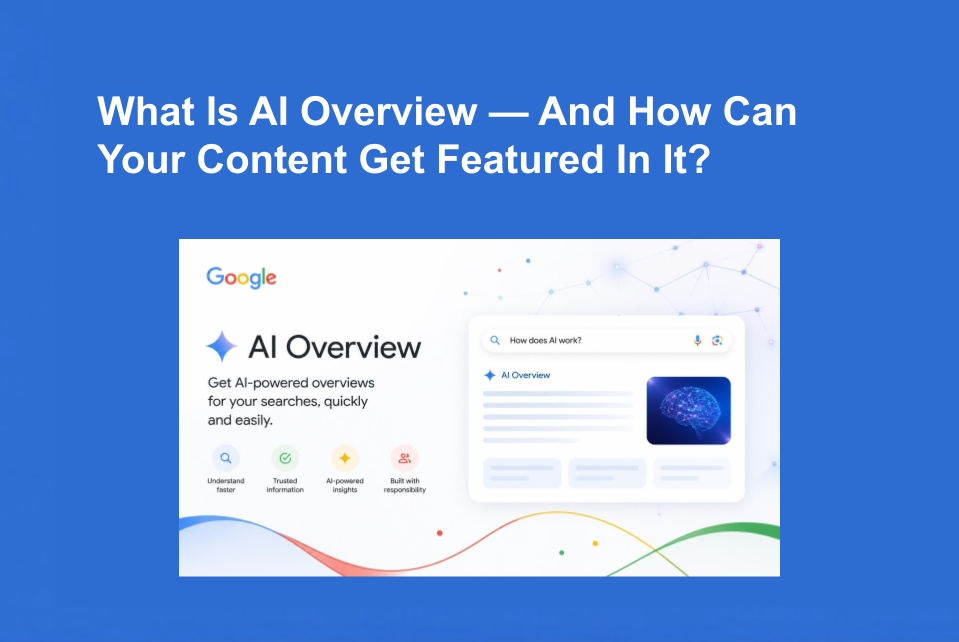
So, what is AI Overview? AI Overview (often shortened to AIO) is Google’s AI-generated summary that appears at the top of the search results. Instead of leaving you to open and compare several pages, it pulls and synthesises the key points from multiple high-ranking sources into one concise answer, with links to the pages it drew from.
The feature did not appear overnight. It grew out of Google’s Search Generative Experience (SGE), first tested in 2023, before being rebranded as AI Overview and rolled out to more than 100 countries and 200-plus markets. What once needed a Search Labs opt-in is now simply part of everyday Google Search. Under the hood it is powered by Google’s Gemini models, which is why it can understand long, complex and conversational questions rather than just single keywords. It is worth separating two related things: AI Overview is the summary you see on the results page, while AI Mode is a deeper, multi-step conversational experience you can step into for follow-up questions.
| Aspect | Traditional search results | Google AI Overview |
|---|---|---|
| What you see | A ranked list of links | A written AI summary with cited links |
| Clicks to get an answer | Usually several | Often none |
| Source visibility | Each site listed separately | A few sites cited inside one answer |
How Google AI Overview Works in Search
How it pulls and cites sources
Google AI Overview does not invent answers out of thin air. It draws on several already high-ranking pages, stitches their key points together, and displays cited source links that users can click to read more. That single detail matters enormously: ranking well is still what feeds the summary, so the AI Overview search experience rewards the same strong content that classic SEO does. AI Overview shows up most on informational, complex, multi-step and “how” or “why” style queries — exactly the questions where a user would otherwise open five tabs.
The formats you will see
AI Overview appears in a few different shapes. The standard format is expanded at the top of the page. A collapsed format shows a short answer that the user clicks to expand. And in some cases there is no AI Overview at all — Google tends to hold back on sensitive “Your Money or Your Life” topics such as medical, legal or financial queries, on very simple factual searches that already have a clear answer, and when it cannot find enough trustworthy sources. When it does appear, the answer often takes the form of ordered or unordered lists, step-by-step recipes, or even code snippets, depending on what the question calls for.
A Quick Note on AI Overview Ads
Yes, AI Overview has ads, and it is worth knowing they exist. Google can show Search and Shopping ads above, below, and sometimes within the AI Overview, clearly labelled as sponsored — a move Google confirmed at Google Marketing Live 2025. That said, keep AI Overview ads in proportion: the in-overview ad format is rolling out in select markets first, and for most Hong Kong businesses paid Shopping placements are not the priority. In Hong Kong, the more sustainable and cost-effective route is organic — earning your place in the summary through SEO and GEO. That is where the rest of this guide focuses.
How AI Overview Affects Your SEO and Traffic
The most talked-about effect is the rise of zero-click searches. When the answer sits on the results page, users get what they need without visiting anyone’s website, so click-through rates can fall even while your rankings stay exactly where they were. It is a genuine shift, but it is not the end of SEO.
Remember that Google AI Overview sources its answers from high-ranking pages. That makes SEO the input to being cited, not something the summary replaces. Alongside it, a newer discipline has emerged: GEO, or Generative Engine Optimisation — shaping your content so AI engines (Google AI Overview, and also tools like ChatGPT and Gemini) quote your brand. In practice SEO and GEO overlap heavily and are done together. What shifts is the emphasis: long-tail and conversational queries grow in value, and structured data plus genuine content quality and E-E-A-T (Experience, Expertise, Authoritativeness, Trustworthiness) become decisive.
| Factor | Before AI Overview | After AI Overview |
|---|---|---|
| Clicks | Ranking = traffic | Ranking may still mean zero clicks |
| Visibility | Position on the list | Being cited inside the summary |
| What to optimise | Keywords and links | Answers, structured data, E-E-A-T (SEO + GEO) |
How to Get Your Content Featured in AI Overview
This is the part that pays off. Getting cited in AI Overview is an organic effort — a blend of SEO and GEO — and it suits the Hong Kong market far better than chasing paid placements. Here is a prioritised checklist you can act on.
Make sure crawlers can reach you
Start with the basics that quietly block everything else. Check that your robots.txt and any CDN or firewall rules allow Google’s crawlers, and AI crawlers, to reach your pages. A single wrong setting means zero visibility, no matter how good your content is.
Write clear, answer-first, text-based content
AI Overview extracts text, so lead with the answer. Put the direct response at the top of a section, use clear question-and-answer phrasing, and keep the structure concise and scannable. Make sure your primary content lives in text rather than being locked inside images or video, and use quality images and video only to support it, always with descriptive text and alt attributes.
Add and validate structured data
Structured data tells Google exactly what each part of your page means, and it is close to a must-have for citation. Use correct, matching schema — FAQ, HowTo, Product, Article — inserted consistently across the site, and never fake or duplicate data just to game it.
Strengthen internal linking and page experience
Help crawlers move through your site with solid internal links — categories, tags and related posts all count — and reward visitors with fast, mobile-friendly, accessible pages that meet Core Web Vitals. Good page experience has long been an SEO signal, and it feeds AI citation too.
Build topical authority and trust (E-E-A-T)
Ultimately, quality and credibility decide who gets cited, not who publishes the most. Demonstrate real experience and expertise on your topics, and keep your Google Business Profile and Merchant Center accurate so local and shopping signals reinforce your trust. Treat the whole checklist as SEO and GEO working together — the organic method that fits Hong Kong.
How to Track AI Overview Performance
Measuring AI Overview is tricky because Google’s reporting is still limited. Google Search Console does count AI Overview activity within Search: a click is logged when someone clicks an AIO source link, an impression is counted when the expanded view is scrolled into view, and the whole AI Overview counts as a single ranking position even when several links appear inside it. What GSC does not yet do is split AIO data out from your traditional SEO data, so you have to read the signals instead. Watch your long-tail question-and-answer keywords for shifts in impressions and clicks, and look for sharp CTR drops while your rankings hold steady — a classic sign that an AI Overview is intercepting the click. Third-party tools such as Ahrefs or Semrush can help spot which keywords trigger AIO citations, but treat those numbers as directional rather than exact.
Frequently Asked Questions
Is AI Overview available in Hong Kong?
Yes. AI Overview is live across more than 200 markets, so Hong Kong users encounter it in everyday search. The one caveat is the in-overview ad format, which is rolling out to a shorter list of select markets first.
Does AI Overview hurt my SEO?
It can reduce clicks, because some users get their answer without visiting your site. But your ranking is exactly what feeds those citations, so the right response is to adapt with SEO and GEO — not to abandon organic search.
How do I get my website cited in Google AI Overview?
Make your site crawlable, publish answer-first content in text, add correct structured data, and build genuine E-E-A-T. In short, strong organic SEO and GEO are what earn the citation.
Can I stop my content appearing in AI Overview?
Yes. You can add the robots meta tag max-snippet:0 to limit snippet use, or apply data-nosnippet to specific elements you do not want summarised.
Conclusion
Google AI Overview is reshaping search, moving it from a list of links toward direct, AI-written answers — and that brings real zero-click pressure. But it still rewards strong organic optimisation, and understanding what AI Overview is puts you ahead of most competitors. For Hong Kong businesses, ads are optional; organic is the priority. If you want to position your content to be the cited source, First Page HK can help with a tailored SEO and GEO assessment — get in touch for a strategy session.
You can also explore how automated answers work by reading Google’s AI Features guide.
Last reviewed and updated on 10/08/2026.