Technical SEO Guide: Meta Tags, Schema Markup, SSL & Image
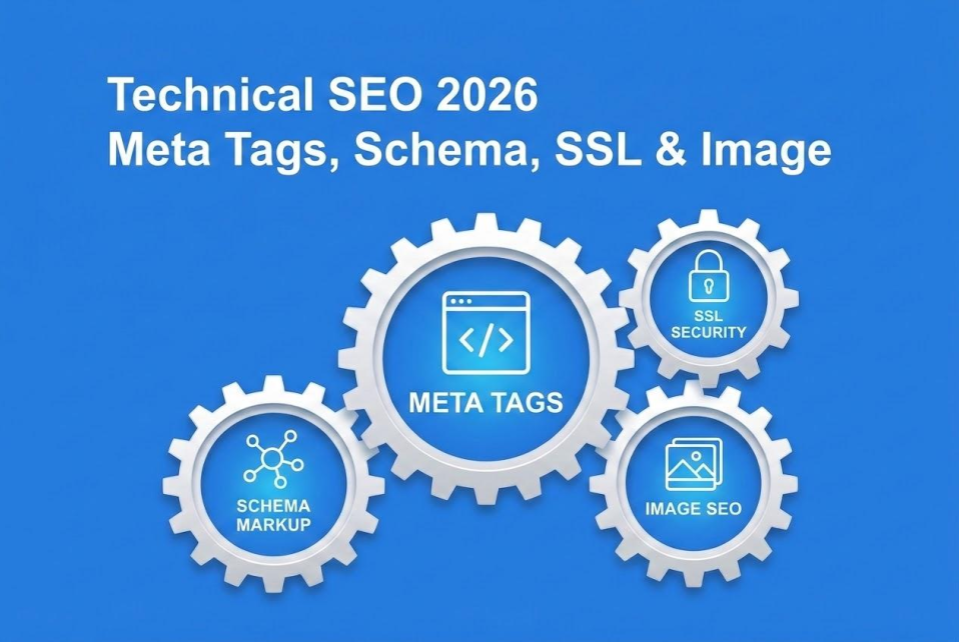
Search has changed fast, but the fundamentals have not. Whether a customer finds you through a classic Google result or an AI-generated answer in ChatGPT or AI Overviews, the engine still has to crawl your page, understand it, and trust it before it will ever recommend you. That is what technical SEO does. In this 2026 guide we focus on the four fixes with the best effort-to-reward ratio for a Hong Kong business: meta tags, schema markup, SSL, and image SEO. Get meta tags seo right and the rest follows — none of these are complicated, and most are quick wins you can action this week.
Table of Contents
- Meta Tags SEO: The Signals Search Engines Read First
- Schema Markup: Help Search Engines (and AI) Understand Your Page
- SSL & SEO: Why HTTPS Is Non-Negotiable in 2026
- Image SEO: Faster Pages and Extra Search Visibility
- Your 2026 Technical SEO Quick Checklist
- FAQ
- Conclusion
Meta Tags SEO: The Signals Search Engines Read First
Meta tags are small snippets of HTML that sit in the <head> of your page. They do not show up on the page itself, but they tell search engines and browsers what the page is about. In 2026, meta tags seo still matters because these tags shape how you appear in the search results and directly influence whether someone clicks. AI search may be growing, but a clear title and description remain the first thing an engine reads about your page — and the first thing a human sees before deciding to visit. Two meta tags do most of the heavy lifting, so we will look at those in detail and then cover the rest briefly.
| Meta tag | What it does | SEO impact |
|---|---|---|
| Meta Title | Sets the clickable headline in the SERP and browser tab | High — a ranking and click-through factor |
| Meta Description | Summarises the page under the title | Indirect — drives click-through, not rankings |
| Meta Robots | Tells engines whether to index or follow the page | High — controls what gets indexed |
| Viewport / Charset | Handles mobile rendering and character encoding | Supporting — mobile usability and correct display |
Meta Title — Your Most Important Meta Tag
The meta title is the clickable blue headline you see in the search results, and it is also what shows in the browser tab. It is not the same as your on-page H1 or heading tags — those live in the visible content, while the title tag lives in the <head>. To write a strong one, keep it to roughly 50–60 characters so it does not get cut off, put your primary keyword near the front, and give every page its own unique title. A reliable formula is Primary keyword – Secondary keyword | Brand. For example, a weak title like “Home | Our Company” wastes the space, while “SEO Services in Hong Kong – Rank Higher | Acme” tells both Google and the reader exactly what to expect.
Meta Description — Your Free Ad Copy in the SERP
The meta description is the short snippet of text shown under the title in the results. It is not a direct ranking factor, but think of it as free ad copy: a good one lifts your click-through rate, and that traffic is what you are really after. Aim for about 150–160 characters, work the keyword in naturally, and finish with a clear reason to click — an offer, a benefit, or a simple call to action. Keep it unique for each page. One thing to remember: Google sometimes rewrites the description using text from your page, so make sure your body copy supports the message you want the snippet to send.
Other Meta Tags Worth Knowing
A few more tags round out a healthy setup. The meta robots tag controls indexing and crawling (index/noindex, follow/nofollow). The canonical tag points to the preferred version of a page to avoid duplicate-content issues. The viewport tag makes your page render correctly on mobile, while the charset tag sets character encoding. Finally, Open Graph and Twitter Card tags control how your link looks when shared on social media.
Schema Markup: Help Search Engines (and AI) Understand Your Page
So what is schema markup in seo? It is structured data — code from the schema.org vocabulary — that you add to your HTML to explicitly label what your content is: a product, a review, an FAQ, a local business, an article. Instead of leaving the engine to guess, schema markup spells it out. Here is how it works: search systems read the markup to remove any ambiguity about your page, which can unlock rich results such as star ratings, FAQ drop-downs, and prices directly in the SERP. In 2026 this matters twice over — rich results lift your click-through rate, and the same explicit labelling helps AI engines understand and cite your content in their answers.
| Common schema type | Best for |
|---|---|
| Organization | Your brand’s core identity and logo |
| LocalBusiness | Shops, clinics and offices with a physical HK location |
| Product | E-commerce product pages with price and availability |
| Review | Star ratings on products or services |
| FAQPage | Pages with question-and-answer content |
| Article | Blog posts and news content |
Adding it is straightforward. Pick the type that fits your page, generate the JSON-LD (Google’s Structured Data Markup Helper or an AI tool will do this for you), paste the code into the <head>, and then validate it with Google’s Rich Results Test or the Schema Markup Validator to make sure it is error-free.
SSL & SEO: Why HTTPS Is Non-Negotiable in 2026
SSL is the technology that encrypts the connection between a visitor’s browser and your server. You can spot it by the padlock icon and the https:// at the start of your address. If you have ever wondered how important is ssl for seo, here is the short answer: HTTPS is a confirmed Google ranking signal. It is a light one, but the bigger story is trust — browsers now label any non-HTTPS site as “Not secure”, which quietly scares away clicks and kills conversions before a visitor even reads your page.
Beyond rankings, ssl seo brings practical benefits. It secures checkout pages and contact forms, which is essential for any Hong Kong e-commerce site handling customer data, and it keeps you eligible for modern, faster web protocols. To get it right, run through a quick checklist: install a valid SSL certificate, force HTTPS with 301 redirects, update your internal links, canonicals and sitemap to the secure URLs, and fix any “mixed content” warnings where a secure page still loads an insecure image or script.
Image SEO: Faster Pages and Extra Search Visibility
Images are usually the heaviest thing on a page, which is exactly why image seo is worth your time. Optimise them well and you improve load speed and your Core Web Vitals scores; you also open up a second stream of visitors from Google Images. The good news is that the wins here are simple and mostly one-time.
Start with the basics: give files descriptive names (blue-widget.jpg rather than IMG_001.jpg) and write meaningful alt text, which helps both accessibility and gives search engines context for the image. Compress every image and serve next-gen formats such as WebP or AVIF to cut file size without losing quality. Set explicit width and height so the page does not jump around as it loads, and use responsive images with lazy loading so visitors only download what they need. Alt text and image structured data also help your pictures show up in image search, tying this back to the meta and schema work above.
Your 2026 Technical SEO Quick Checklist
Here is the whole guide boiled down to an action list you can work through this week:
| Pillar | Action | Priority |
|---|---|---|
| Meta tags | Unique meta title and meta description on every key page | High |
| Schema markup | Add and validate relevant schema (LocalBusiness / Product / FAQ) | High |
| SSL | Full HTTPS, redirects in place, no mixed content | High |
| Image SEO | Compressed, named, alt-tagged and right-sized images | Medium |
FAQ
What are meta tags in SEO and do they still matter in 2026?
Yes. Meta tags seo is still relevant: your meta title and meta description shape how your page looks in the search results and drive click-through, while tags like robots and canonical control how your pages get indexed.
What is schema markup in SEO?
Schema markup is structured data you add to your page to label your content — a product, review, or business — so search engines and AI systems understand it clearly and can show rich results like star ratings and FAQs.
How important is SSL for SEO?
It is important. HTTPS is a Google ranking signal and, just as crucially, a trust factor. Sites without SSL are flagged “Not secure” in the browser, which costs you clicks and conversions.
How do I improve image SEO?
Compress your images, use descriptive file names and clear alt text, and serve next-gen formats like WebP. This speeds up your page and helps your images rank in Google Images.
Conclusion
Meta tags, schema markup, SSL and image SEO are the technical fundamentals that give you the most return for the least effort in 2026 — and the good news is that most are quick wins you can start on this week. Nail your meta tags seo, label your content with schema, lock everything behind HTTPS, and keep your images light. If you would rather have experts find and fix what is holding your rankings back, get a professional technical SEO audit from First Page and turn these fundamentals into results.
Last reviewed and updated on 31/07/2026.